
Why Travertine Dulls in Las Vegas
Travertine is the most common natural stone flooring in the Las Vegas valley. From 2000 to 2010, when Anthem, Summerlin, Henderson's Green Valley Ranch, and Seven Hills filled in with master-planned homes, builders installed travertine in entryways, kitchens, primary baths, and pool decks across nearly every premium build. Two decades later, those floors are entering their primary restoration window.
Three regional factors do most of the damage. First, Las Vegas tap water carries 285 to 575 milligrams per liter of dissolved minerals (Southern Nevada Water Authority data), one of the hardest water profiles in the United States. Calcium and lime deposit on travertine constantly, dulling the surface and creating a chalky film that no mop can remove. Second, Las Vegas desert dust settles into travertine's natural voids on a daily basis. Wind events and monsoon haboobs turn that dust into a deep pack that grinds against the stone underfoot. Third, Las Vegas UV is among the most intense in the country at 2,001 feet of elevation. Topical stone sealers degrade here faster than in coastal markets, exposing the polished surface to acidic spills and household cleaners that cause etching.
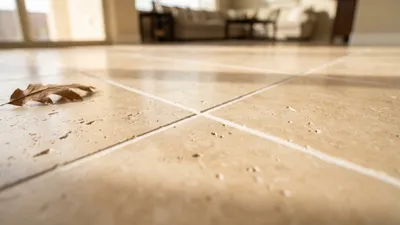
The result is the floor most Las Vegas homeowners eventually see: dull patches in high-traffic lanes, white cloudy spots where lemon water or vinegar splashed, surface pits that catch grit, and a complete loss of the original showroom shine. Replacement runs ten to twenty thousand dollars for an average travertine layout. Restoration costs a fraction of that and produces a floor that often looks better than the day it was installed.
What Diamond Polishing Actually Does
Diamond polishing is not a coating or a wax. It is a mechanical resurfacing process that physically removes the top layer of travertine and reveals fresh, uncompromised stone underneath. A planetary head fitted with diamond-impregnated abrasive pads passes over the floor in successive grit stages. Each pass cuts shallower than the last. The first pass removes etch marks, scratches, and the worn top layer. The middle passes refine the surface. The final ultra-fine pads bring out reflectivity and depth.
This is the same process used to restore travertine in luxury hotels, museums, and historic buildings. The reason it works on stone in residential homes is that travertine, marble, and limestone are calcium carbonate. They polish, while ceramic and porcelain tile do not. A diamond head moving across travertine removes a thin sliver of stone uniformly, leaving the surface flatter and more reflective than it was before the damage occurred.
The misconception worth correcting is that polishing damages the stone. The opposite is true. Each polishing pass uses progressively finer abrasive than the previous one, the way fine sandpaper smooths wood after coarser sandpaper has done the rough work. The travertine you see after a meticulous diamond polish has less surface roughness, fewer micro-scratches, and more reflective character than untouched stone of the same age.
The Royal Surface Restore Process
Your technician assesses every travertine floor before quoting a price. The starting grit, the number of passes required, and whether voids need filling all depend on the stone's current condition. A floor with light dulling and minor traffic wear may start at a medium grit and need three passes to a high polish. A floor with deep etching, large pits, and prior topical sealer residue may need a coarser starting grit, mechanical filling of voids, and four to five passes including a crystallization step on adjacent marble.
The process runs in this sequence. Surface inspection establishes the etch depth and lippage between tiles. Deep cleaning removes wax, dirt, and prior sealer residue so the diamond pads contact bare stone. Progressive diamond polishing moves through coarse, medium, fine, and ultra-fine pads, each pad isolated from the previous to avoid cross-contamination. Travertine voids that bother the homeowner are filled with color-matched stone filler before the final two polishing stages, so the filler is leveled and polished into the surface rather than sitting on top of it. A penetrating stone sealer is applied at the end. Final buffing and inspection happen with the homeowner walking the floor in varied light, since travertine reflects differently under daylight versus interior lamps.
The whole process for an average Las Vegas main floor runs one to two work days. The polish compounds Royal Surface Restore uses are eco-friendly and emit no harsh fumes, so the home stays comfortable while work is in progress. The floor is walkable as soon as the sealer cures, typically four to six hours after application.
Filling Pits and Voids: The Travertine Question
Travertine forms in hot springs and limestone caves, and the natural cavities in the stone are part of its character. Some homeowners love the rustic, organic look of unfilled voids. Others find them frustrating because they catch dust, food crumbs, and pet hair, and they are nearly impossible to keep clean.
When your technician quotes a travertine floor, you'll be asked which side of that question you fall on. If voids are part of why you bought the stone, restoration leaves them intact, with cleaner, sharper edges than they had before. If voids have become a maintenance headache, color-matched stone filler is applied during the polishing process, blending the surface into a continuous, easy-to-clean plane. The filler is harder than typical grout and bonds chemically with travertine, so it does not pop out under foot traffic the way some DIY repair kits do.
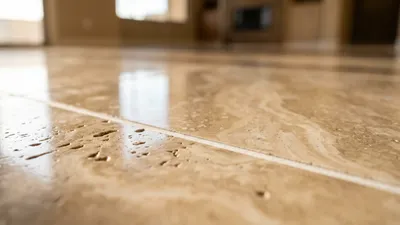
This is one of the moments where the phrase "the royal treatment" earns its keep. A travertine floor that has been progressively polished, voids consistently filled, and sealed against Las Vegas hard water looks like a different floor. Reviewers often say it looks better than the day it was installed, because the original construction sealer was thinner and the original install rarely matched grit progression as carefully as a restoration job does.
Sealing for Las Vegas Conditions
A polished travertine floor is more vulnerable than a polished granite floor. Travertine is softer, more porous, and more reactive to acids. The right sealer matters more in Las Vegas than almost anywhere in the country because the water is harder, the dust is more abrasive, and the UV is more aggressive.
Royal Surface Restore uses penetrating stone sealers that bond inside the travertine's pore structure rather than sitting on top of the surface as a film. Penetrating sealers do not yellow under UV the way topical sealers can, they do not flake or peel, and they do not require periodic stripping and reapplication of a coating. A correctly applied penetrating sealer on travertine in a Las Vegas home typically lasts two to five years before needing a refresh, depending on traffic volume and the cleaning products in use.
A note on cleaning products. Avoid acidic cleaners on sealed travertine in Las Vegas. Vinegar, lemon-based products, citrus cleaners, and any "natural" descaling product designed for hard water will etch the stone, even through a high-quality penetrating sealer. The cleaners that work best on travertine are pH-neutral stone-safe formulas, used with soft microfiber rather than abrasive pads. Your technician leaves a written care card with every restoration job that lists the products that are safe and the products to avoid.
What Travertine Restoration Costs in Las Vegas
Travertine restoration pricing in Las Vegas follows the size and condition of the floor. A small project, such as a kitchen backsplash, a powder room floor, or a single bathroom, typically falls between $200 and $400. A typical Las Vegas main floor (entry, kitchen, dining, hallway, primary bath) runs between $400 and $1,200. A whole-home travertine restoration or estate-level project runs between $1,200 and $2,500 or more, depending on square footage and stone type.
For planning purposes, expect $5 to $15 per square foot. The lower end applies to floors with light dulling and no filling required. The higher end applies to floors with deep etching, extensive filling, marble crystallization, or premium sealer. Royal Surface Restore provides a free on-site estimate before any work begins. The estimate is binding. There are no surprise charges and no upsells.
Compared to replacement, restoration runs five to ten percent of the cost of tearing out and reinstalling travertine. That alone is the reason most Las Vegas homeowners choose restoration once they understand the process. The pristine result and the absence of demolition are why they recommend it to their neighbors.
When to Polish, When to Replace
Restoration is the right answer for the vast majority of Las Vegas travertine floors. The exceptions are narrow but worth naming clearly.
Replace when the substrate has failed. If multiple tiles are loose, cracked, or lifting because of slab movement or original install error, no surface restoration corrects that. Replace when the travertine has been resurfaced or coated multiple times and the remaining stone is too thin to polish safely. This is rare in residential settings but occasionally turns up in homes that have been through several owners with different DIY repair attempts. Replace when the homeowner specifically wants a different stone or layout, since restoration preserves the existing material.
In every other situation (dull, etched, pitted, scratched, stained, water-marked), diamond polishing is the right call. Your technician will tell you honestly during the on-site assessment whether your floor is a restoration candidate or a replacement candidate. Royal Surface Restore has turned away jobs that were not appropriate for restoration. Five-star reviews that name our team almost always mention this kind of straight talk.
Where We Restore Travertine in the Las Vegas Valley
Royal Surface Restore works across the entire Las Vegas metro. Travertine concentration follows housing-stock age, and the densest pockets are in Anthem, Summerlin, Henderson's Green Valley Ranch, and Seven Hills, where 2000 to 2010 master-planned builds installed travertine as a premium standard. Royal Surface Restore also works in older Las Vegas neighborhoods where travertine has been added during remodels, and in newer Henderson and Enterprise homes where premium upgrades included natural stone.
The travel radius is the entire valley. There is no extra fee for jobs in Anthem, Summerlin, Henderson, or Centennial Hills compared to jobs near our 1702 Western Avenue location.
Ready to Restore Your Travertine?
If your travertine floors look dull, etched, pitted, or simply tired, restoration almost certainly produces a result you will be proud of. Get a free on-site estimate from our team. Phone or text 702-577-7474, or use the contact form for a same-day callback. The royal treatment your floors deserve is one phone call away.
For a deeper look at the diamond polishing process, photos from completed Las Vegas projects, and the full pricing table, visit the stone and marble polishing service page.